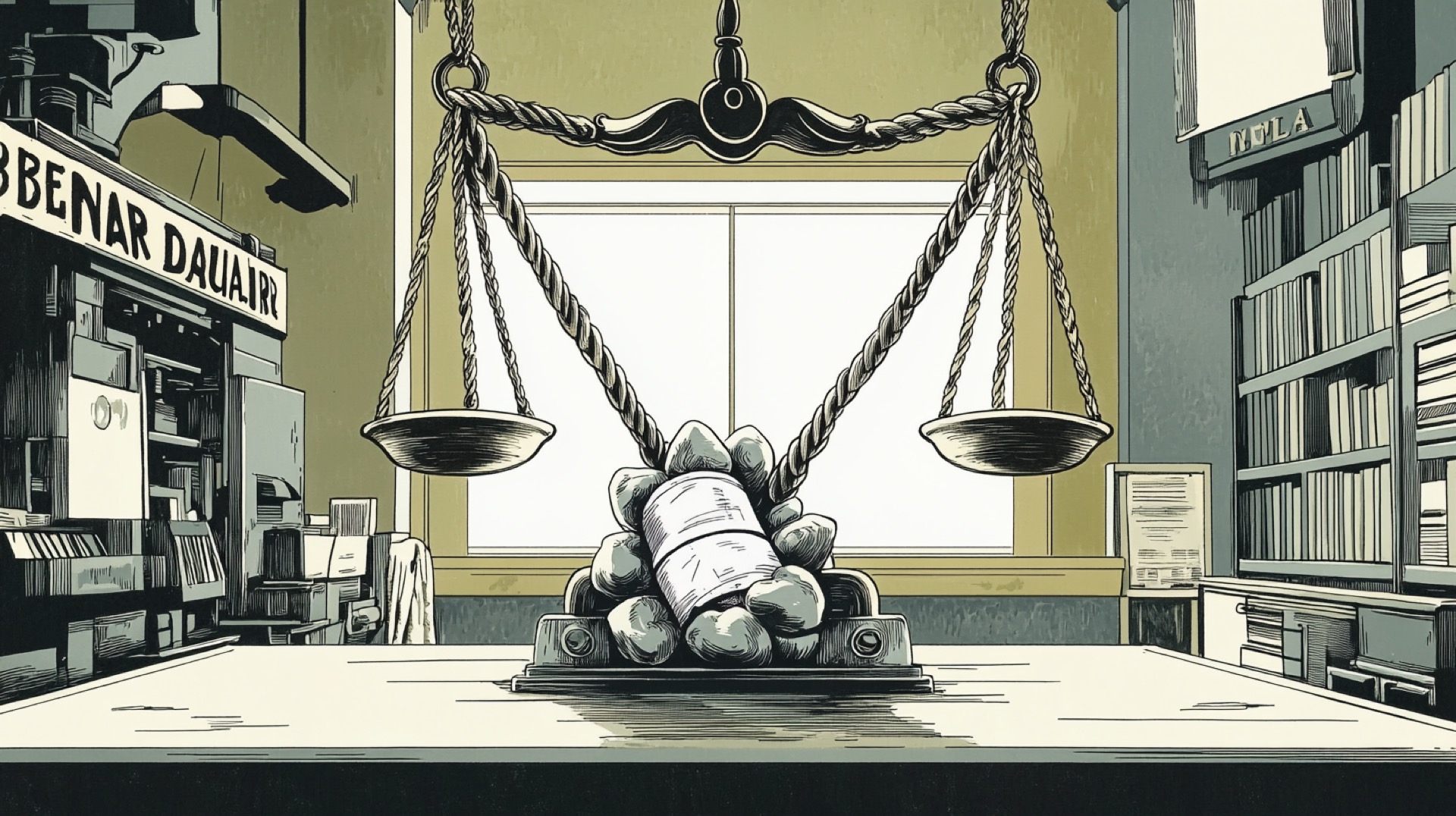
Thesis. Both-sideism is not neutrality; it is a production method. It assigns equal weight to unequal claims, awards airtime as if truth were a parity contract, and punishes the outlets that still test reality before publishing. In today's asymmetric politics—where one party's leaders more routinely attack the press, launder disinformation through friendly channels, and leverage state power to chill scrutiny—this method doesn't "balance" coverage. It subsidizes bad faith and bankrupts independent, critical media.
What follows goes broader than a single news cycle, but the symptoms are visible this week: a White House staging the news and instructing the press how to frame it, while campaign surrogates delight in the spectacle of newsrooms under siege. The glee is not incidental; it is strategic.
⸻
I. What both-sideism is—and why it thrives
Both-sideism is the habit of giving symmetrical space to asymmetrical claims. The intent looks noble—"objectivity," "fairness"—but the effect is distortion when the evidentiary weight is lopsided. Journalism has known this for years in science beats: false balance on climate trained audiences to doubt a consensus that was never seriously in doubt. That error has migrated to politics.
Why does it persist? Three incentives do the quiet work:
Risk shifting. Editors fear accusations of bias more than they fear obscuring the truth. "We quoted both sides" functions as an insurance policy against partisan blowback, even when one side is inventing facts.
Process worship. In a fragmented market, institutions defend their brand by foregrounding procedure—we asked X for comment; we presented Y's view—over proportionality. The ritual becomes the product.
Access economics. Campaigns and officials grant or throttle access. Outlets that challenge more lose more: fewer briefings, fewer calls returned, fewer "exclusives." When the White House can reshape the press pool or sideline wire services, access converts into leverage—and both-sideism becomes a survival reflex.
⸻
II. The asymmetry problem, stated plainly
Both-sideism collapses when one party treats the press as an enemy to be humiliated or captured. In practice, that asymmetry has meant (1) disinformation campaigns channeled through partisan media ecosystems; (2) direct attacks on independent outlets via threats, lawsuits, and exclusion from pools; and (3) structural moves to defund or delegitimize public-service journalism. The cumulative signal to newsrooms is simple: "Cover us on our terms—or pay."
Consider a few concrete pressures:
Delegitimization as strategy. The long march of "enemy of the people" rhetoric culminates in spectacle—officials mocking and trolling reporters in public—and in policy, such as reconfiguring pool access to control who asks questions. This is not "savvy comms"; it is message discipline by intimidation.
Lawfare and liability. The largest defamation reckoning in U.S. media history—Fox's $787.5 million settlement with Dominion—did not deter others equally; it mostly proved how profitable narratives outrun facts until a court intervenes. Smaller, independent outlets cannot survive one such blow; knowing that, political actors pick targets.
Public broadcasting under the knife. Cutting off CPB funding and ordering the system to cease support for NPR/PBS is not "budget trimming." It strips lifelines from rural and small-market stations that anchor independent coverage where commercial incentives fail. That change lands hardest where news deserts already spread.
Both-sideism misreads all three as symmetrical grievances. They are not. They are one-directional attempts to discipline an accountability layer.
⸻
III. How both-sideism rewards the lie—and punishes the check
Two empirical anchors matter.
First, the 2016 precedent: systematic research from Harvard's Shorenstein Center found coverage overwhelmingly negative for both candidates, light on policy, and primed by scandal frames (with "emails" dominating). Negativity parity felt "balanced"; the informational result was not. An asymmetrical willingness to flood the zone with norm-breaking claims gained free amplification in "he said/she said" formats. That template never really left.
Second, the defamation incentives: The Dominion case shows what happens when narrative beats verification at scale; internal messages revealed awareness of falsity even as broadcasts continued—a market signal that attention outruns accuracy until the liability number becomes unbearable. Independent outlets can't "carry" that risk; many pre-emptively soften or skip high-conflict fact patterns rather than fight costly battles.
Add platform dynamics and you get gravity: Meta's retreat from the News tab and the broader social referral collapse have reduced the discoverability of original reporting precisely when officials prefer managed narratives. When traffic depends less on shared links and more on closed video formats or politicized recommendation systems, the costs of meticulous reporting rise as the rewards fall.
In that economy, both-sideism is a subsidy to speed. You quote the claim and the counterclaim, you file, you move on. The lie benefits from repetition; the verification dies in the sidebar.
⸻
IV. The structural wreckage: collapsing pipes for local reality
Independent, critical media starts locally: school boards, zoning, sheriffs, ballots. That pipe is cracking. Northwestern's Medill project shows nearly 40% of U.S. local newspapers gone since 2005, with ~50 million Americans living in counties with little or no local news—news deserts. AP and others report more closures this year, with rural areas hit hardest. As these lights go out, party-built outlets and Facebook groups fill the space, and both-sideism turns from a style problem into a democracy problem.
Public media cushioned the blow—until 2025. Federal clawbacks and an explicit push to defund CPB imperil precisely the stations that keep independent reporting alive outside big metros. A newsroom that loses base funding cannot choose "weight-of-evidence" framing over "both sides"; it chooses survival, then silence.
⸻
V. What audiences believe—and why it matters
Trust has tanked overall and polarized sharply by party. Gallup's latest shows trust at or near record lows; Pew finds Republicans remain far less trusting of national news than Democrats, even after a modest uptick this year. Both-sideism was supposed to protect credibility by looking neutral. Instead, it taught audiences that truth is a matter of angle, not evidence. When trust becomes a team jersey, the only "safe" coverage is stenography.
⸻
VI. Case studies in normalization (and what to do instead)
Platformed falsehoods. When an official asserts a claim known to be false, running a headline that repeats the falsehood—even with "without evidence"—strengthens the frame. A better practice already exists: truth-first, claim-summarized, truth-again. Weight the coverage to the evidence, not the spectacle. ("Truth-sandwich" and "weight-of-evidence" reporting are not partisan tricks; they're guardrails.)
Access blackmail. If the pool can be rewritten to sideline independent wires, treat access loss as a story about power, not a newsroom's private grievance. Tell audiences what changed and why it matters; insist on written criteria; litigate where necessary. (Reuters highlighted the danger clearly this spring.)
Hired "balance," fired clarity. The Ronna McDaniel episode wasn't a culture-war scuffle; it was an object lesson. "Balance" by hiring a figure who propagated election subversion collapses when the basic test is democratic bona fides. Newsrooms should distinguish perspective diversity from anti-democratic advocacy and say so.
Lawfare judo. After Dominion, some editors over-correct by avoiding hard assertions about repeat misinformers. That's backward. The case supplied a toolkit: internal documents, intent evidence, and a judicial record that the statements were false. Use it. Call a falsehood false. Avoid euphemisms that convert lies into "controversies."
⸻
VII. Why both-sideism uniquely advantages Republican politicians now
This is not metaphysics; it's market structure plus strategy. When one party's national apparatus more consistently embraces (a) narrative discipline through friendly networks, (b) delegitimization of independent outlets, and (c) the instrumental use of government to shrink or steer the news ecosystem (public broadcasting defunding, pool manipulation), a form that awards equal billing regardless of proof is a force multiplier for that party. It grants discount carriage for propaganda and imposes premium pricing on verification. That is the asymmetry the Salon piece surfaces: officials stage "news," then scold reporters for insufficient compliance. The cruelty is not the point; the coaching is.
⸻
VIII. The newsroom fix: eight concrete changes
Adopt evidence-weighted style. Make "weight of evidence" the default template for coverage where the fact base isn't split. Describe the distribution of expert judgment. Visualize it when possible: "N of 20 credible studies find X; 1 finds Y; 0 replicate Z."
Truth-first framing. Headlines lead with what is verified, not with what is said. If you must quote the falsehood for accountability, bracket it with the established fact. (No more "without evidence" hedges when the evidence is known to be negative; say "contradicted by [specific finding].")
Asymmetry-aware beats. Create beats for threats to democratic infrastructure (press access rules, CPB funding, election administration) that cut across party lines but recognize directionality when it exists. Treat access throttling as coverage-worthy policy, not inside baseball.
Escalation protocol for serial misinformers. After three documented, material falsehoods, downgrade live coverage and require on-screen/context boxes that display the track record. This isn't censorship; it's labeling, akin to conflict-of-interest disclosures in business stories. (Defamation cases have already established falsity in some domains; use the record.)
Open your books to your readers. Publish sourcing notes and denial timelines: Who said what, when did we ask, what documents did we inspect. Trust survives transparency better than it survives theatrical neutrality.
Network the locals. Build federated investigative desks that let small outlets share counsel and data tools. The economics of local truth are collapsing; shared infrastructure is how independent media punches back. (The news-desert data is your business case.)
Philanthropy and policy, not pity. Support public-interest reporting with recurring grants that buy reporter hours, not only "innovation pilots," and press for smart policy: payroll credits for local reporters; ad-buy credits for small businesses in local outlets; refundable reader credits. These are content-neutral; they fund reporting capacity, not lines on a page.
Write the access rules down. The White House Correspondents' Association and major outlets should present a public, evidence-based standard for pool rotation and pass revocation. When the rules are public, retaliatory changes are easier to prove—and to fight.
⸻
IX. Platform reality: stop building on sand
Meta's retreat from the News tab and the broader collapse in social referrals rewired distribution. Independent media cannot depend on platforms that de-prioritize links and reward short, context-free video. Rebuild owned channels (newsletters, SMS, apps) and partner with civic institutions (libraries, universities) for distribution. Do not fit the truth to the For You page. Fit your funnel to your facts.
⸻
X. The public-media front line
The fight over CPB is not a side plot. Gutting public broadcasting amputates affordable reporting in places where markets under-supply it. You don't have to love every NPR segment to see the structural function: weather warnings, school budget coverage, candidate forums. When the state uses the purse to punish independent outlets, the press should not "balance" the story with a ritual quote about "bias"; it should describe the direct effect on emergency alerts, classrooms, and elections. Then show the map.
⸻
XI. What to tell readers, in one paragraph
Tell them this: proportionality is not bias. If one side offers evidence and the other offers slogans, saying so is your job, not a breach of it. The alternative is theater—where trolls set the table and the national press carries the dishes out politely.
⸻
XII. A brief note for editors on tone and law
Be direct. Use the word false when the record demands it. Avoid "claims" and "sparring" when documents exist. If legal anxiety drives euphemism, consult counsel early and often—but don't outsource truth to fear. Dominion showed that courts will enforce facts even when markets won't. Your job is to publish proportionate truth before a judge has to.
⸻
XIII. Closing: choose the spine, not the split
Independent, critical media will not be saved by splitting the difference between reality and its imitation. Both-sideism once looked like a shield. In an asymmetric environment, it is a funnel, channeling power's narrative straight through the newsroom into public life. Replace it with evidence-weighted reporting, transparent methods, and a calm refusal to equate bad faith with good. The cost of that spine is measurable: fewer invites, more attacks, occasional lawsuits. The benefit is also measurable: a public that can tell when the administration is staging the news, a community that can see how defunding its local station will silence its emergencies, and an electorate that remembers elections are for citizens, not for storylines.
⸻
Selected sources & anchors
- Salon (Oct 24, 2025): on staging the news and press intimidation
- Shorenstein Center (2016): negative-tone, policy-light election coverage patterns
- RSF (2025): economic fragility as a leading press-freedom threat
- Dominion v. Fox settlements: $787.5M (and related repercussions)
- White House/CPB funding conflict (2025): rescission push and shutdown coverage
- Press access policy changes (2025): limiting wire access to the president
- News-desert data (2024–2025): Medill/NU reports and AP synthesis
- Platform shifts: Meta discontinuing Facebook News (U.S.) and referral declines
- Public opinion: Gallup trust lows; Pew's partisan trust gap
- Practice guidance: truth-sandwich and weight-of-evidence reporting
This analysis examines how both-sideism—the journalistic practice of giving equal weight to asymmetrical claims—undermines independent, critical media in an environment where one party systematically attacks press legitimacy. Part of the Sol Meridian series on governance, media, and democratic accountability.